Every Image Screened, Not Just the Ones You Choose to Send

Every Image Screened, Not Just the Ones You Choose to Send

ARTICLE ABSTRACT

This article walks through how automated AI screening complements teleradiology in a real practice workflow: the veterinarian reads the film, the AI corroborates what they saw and surfaces incidental findings, and teleradiology adds a board-certified or board-eligible specialist’s depth on the cases that genuinely warrant one.

The result is in-appointment answers for the pet owner, fewer next-day callbacks, and more focused telerad referrals on the cases that actually need a specialist’s interpretation.

How automatic AI screening adds comprehensive coverage without changing how you practice

Teleradiology is a trusted and valuable part of veterinary practice. When a case calls for a board-certified radiologist’s interpretation, the ability to send images and receive a detailed report has improved patient care across the profession. Most practices have a teleradiology provider they rely on, and that relationship matters.

Vetology’s AI screening serves a different purpose. It is not a replacement for teleradiology, it is a complement that adds something teleradiology was never designed to do: screen every image, automatically, before anyone has to decide which cases need a specialist read.

The two services work hand in hand. AI screening provides the always-on baseline that catches findings on every study. Teleradiology provides a board-certified or board-eligible radiologist’s interpretation on the cases where a specialist’s depth adds the most.

The Difference Between Selective and Comprehensive

Teleradiology works on a case-by-case basis. The veterinarian evaluates the images, identifies cases that would benefit from specialist input, and submits those for review. This is exactly how the service is designed to work, and it works well.

AI screening works differently. When a practice uses Vetology, every radiograph submitted through the workflow is automatically analyzed across 91+ classifiers covering conditions in canine and feline thorax, abdomen, and spine/musculoskeletal categories. There is no selection step. The screening happens on every study, validated on 300,000 board-certified veterinary radiologist-reviewed cases with published sensitivity and specificity for every condition.

This means the AI is reviewing images that the DVM may already feel confident about. Here’s where the added value shows up: A thorax taken to evaluate a cough also gets screened for cardiac changes, lymphadenopathy, and spinal findings. An abdomen taken for GI signs is screened for organ size changes, mineralization, and structural abnormalities. The AI adds breadth to every study, regardless of the original clinical question.

What This Looks Like at 2 PM on a Tuesday
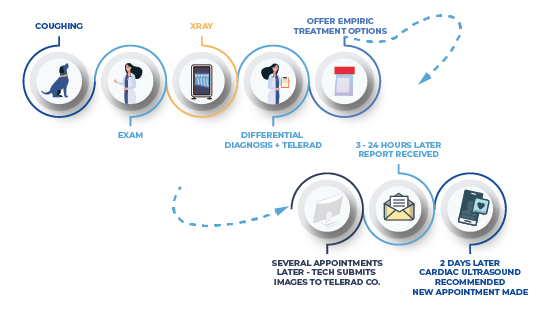
Standard Teleradiology-Only Workflow

A Labrador presents for a persistent cough. You take thoracic radiographs. With teleradiology, you submit the images, move the client out, and call tomorrow with results. The pet parent goes home without answers, and you add another callback to tomorrow’s list.
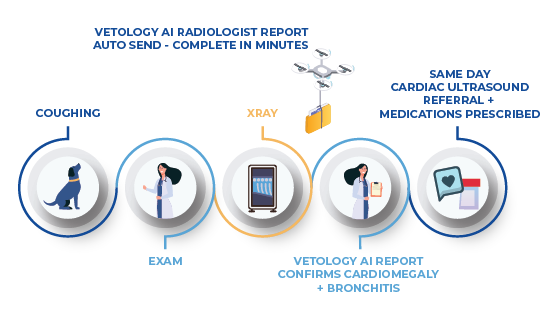
icon graphic showing the veterinary diagnostic imaging workflow with AI

Imaging Workflow with AI in the Mix

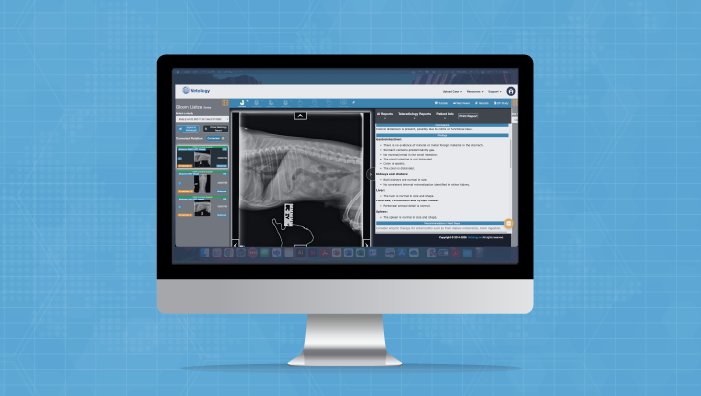
With AI screening, the report is available within minutes, while the client is still in the room. The AI flags a bronchial pattern consistent with your clinical suspicion, but it also notes early left atrial enlargement and mild thoracic lymphadenopathy.

You now have a more complete picture to discuss with the client before they leave. If the lymphadenopathy reading prompts a closer look, you can submit that single case for a teleradiology read knowing exactly why you are asking for one.

The AI surfaces the question; the teleradiologist provides the credentialed answer. When you recommend a specialist read to a pet owner, the recommendation is grounded in something specific you saw on the image.

For some veterinarians, that in-appointment information is exactly what they want. Clients leave with clarity and a treatment plan instead of waiting overnight.

For others, the value is more analytical: five fewer callbacks per day at 8 to 10 minutes each adds up to 40 to 50 minutes of recovered time. That is nearly one additional appointment, or time back in a day that already feels too short. The per-case cost of AI screening on an unlimited subscription is a fraction of a teleradiology read, and the information arrives while it can still shape the visit.

Comprehensive Screening in Practice

In practical terms, AI screening means:

  • A thorax submitted for cardiac evaluation is also screened for pulmonary patterns, pleural findings, mediastinal changes, and thoracic spine conditions.
  • An abdomen submitted for vomiting is also screened for organ size, masses, mineralization, and structural findings across all visible organs.
  • A spine study is also screened for degenerative changes, congenital anomalies, and adjacent soft tissue findings.

The AI presents its findings in a structured report alongside the veterinarian’s own assessment. Some findings will confirm what the doctor already noted. Others may highlight something worth a closer look. The veterinarian always makes the final clinical decision.

This is not about replacing clinical judgment. It is about having a consistent, validated screening layer that catches incidental findings the same way every time, whether it is 9 AM or 5:45 PM on a Friday. When something on the screen warrants a specialist’s interpretation, the AI report helps the veterinarian put a focused clinical question on the teleradiology submission. Instead of “please read these films,” the question becomes “please assess thoracic lymphadenopathy and confirm cardiac silhouette.” The radiologist still reads with fresh eyes, on their own, but the clinician’s question is sharper. That sharper question is what makes the report more useful when it comes back.

How the Workflow Plays Out

You read the radiograph the way you always have. The AI report arrives on the same case within minutes, and you check it against what you saw. Most of the time, the AI confirms your read and may add a few findings you were not specifically looking for. That confirmation is the value. You move to diagnosis and treatment planning with one more layer of corroboration behind your decision, and the structured AI report becomes fast and familiar to read over time.

Some cases do not resolve that easily. The findings are subtle, the clinical picture is unclear, or you and the AI together still cannot get to a confident diagnosis or treatment plan. That is where teleradiology adds a layer of human specialist support. The case goes to a board-certified or board-eligible radiologist who can give the read the depth it needs.

Over time, the rhythm becomes natural. You read, the AI corroborates, and you decide whether you have what you need or whether the case warrants a specialist’s interpretation. The AI is the helper that confirms what you already saw. The teleradiologist is the human specialist you turn to when confirmation alone is not enough.

How the Whole Practice Benefits

Practice managers benefit from more complete initial visits. When more information is available during the appointment, more treatment decisions happen while the client is in the room. This means smoother scheduling, fewer follow-up calls to coordinate, and better client retention. Clients who leave with answers are more likely to follow through on treatment plans and return for follow-ups.

Veterinary technicians gain a new dimension to their work. Techs who capture quality radiographs can see the AI’s findings on the images they produced. Over time, this builds familiarity with a broader range of imaging findings and adds professional development value to the imaging workflow.

Front desk and client services staff benefit from the downstream effect: when appointments are more complete, there are fewer follow-up calls to manage and fewer schedule adjustments to coordinate. The day runs more predictably for everyone.

AI Screening and Teleradiology Work Together

These services answer different clinical questions, and knowing when to use each is part of running an efficient imaging workflow.

Lean on AI screening when:

  • You want a baseline read on every study, including the ones you already feel confident about
  • The pet parent is in the room and a same-visit conversation matters
  • You want a structured screen for incidental findings outside the original clinical question
  • You want to triage which cases in a busy day actually warrant a specialist’s time

Lean on teleradiology when:

  • The case is complex, the findings are subtle, or the clinical stakes are high
  • You want a board-certified or board-eligible radiologist’s interpretation on the medical record
  • The owner is asking for a specialist opinion before committing to next steps
  • You want a credentialed reading you can cite to a referring practice or in a follow-up conversation

In practice, the workflow is straightforward. The AI screens every case automatically. The veterinarian reviews the AI report alongside their own assessment of the films. When something warrants a specialist’s interpretation, the case goes to teleradiology with a sharper clinical question on the submission. The radiologist reads with fresh eyes, the way they always have. The clinician gets a credentialed reading on the cases that need one. The pet parent gets answers in the room when answers are available, and a thorough specialist review when one is appropriate.

Vetology offers both AI screening and teleradiology read by board-certified and board-eligible radiologists, including DACVR/ECVDI diplomates, board-certified cardiologists, and a board-certified dentist. STAT reads return in 2 hours; routine reads in 24. The AI subscription also works alongside whatever teleradiology provider a practice currently uses, so clinics do not have to choose between them.

Simple, Predictable Pricing

Vetology’s AI screening subscription is $200/month for unlimited studies. Not per-case, not tiered by volume. A flat monthly cost that covers every radiograph the practice submits, whether that is a handful per week or dozens per day. No contracts, no PACS required, and free DICOM storage included.

The AI subscription is the practice’s recurring imaging cost. Teleradiology fees, which start at $86 per single-region report, are billed to the pet owner on the cases the veterinarian sends for a specialist read.

The flat AI cost gives the clinic broad coverage on every study; the per-case telerad fee gives the pet owner a credentialed read on the cases that warrant one. Together they make for a more intentional imaging workflow.

The system integrates with widely used practice management systems including DaySmart Vet, ezyVet, VetRocket, ScribbleVet, and CoVet with more on the way.

Want to see AI in action?

To tour the platform and learn more, contact our team, or book a demo for a firsthand look at our AI and teleradiology platform.

How to Use Vetology: 30 Days to a Smart, Practical AI Radiology Workflow 

How to Use Vetology: 30 Days to a Smart, Practical AI Radiology Workflow 

ARTICLE ABSTRACT

Vetology is a veterinary AI radiology platform that pairs automated AI screening of canine and feline radiographs with on-demand access to board-certified and board-eligible radiologists.

Key Takeaways:

  • Setup is fast. A single 45 – 60-minute remote call configures DICOM, account settings, and includes an initial training.
  • The platform works with all major digital X-ray brands and includes unlimited DICOM storage, a built-in PACS, and integrations with select PIMS and AI scribe platforms.
  • Radiographs auto-route to the AI screening tool, and reports return within minutes with findings, conclusions, and recommendations.
  • The recommended workflow is to read the radiographs first, then review the AI report as a structured second look.
  • Board-certified and board-eligible radiologists are available on demand, with STAT reads in two hours, routine reads in 24 hours.
  • Most clinics reach full workflow integration within days, but we continue to provide support with client services check-in at month one, and beyond.

Adding a new tool to any workflow can feel intimidating. But with Vetology’s fast veterinary AI implementation, validated AI screening software, and access to board-certified (and board-eligible) radiologists, you can be up and running in no time. 

Here’s what the first 30 days with Vetology look like, including the teleradiology setup process, veterinary DICOM integration, and team training and support.

Setup and Support

The Vetology support team remotely manages all aspects of setup. During a one-hour scheduled call, the support team will: 

  • Configure your account settings
  • Establish and test your DICOM connection
  • Troubleshoot installation issues
  • Provide initial training

The Vetology platform supports all brands of digital radiograph equipment, and your subscription includes unlimited, free DICOM storage and a built-in PACS (if you need one), this can eliminate the need for separate, expensive storage systems, however, changing your PACS is at your clinic’s discretion. Vetology also integrates with several PIMS and AI scribe platforms, giving clinics the option to submit visit notes to the platform alongside images.

Once the support team configures your hospital’s settings and enables the “auto-send” feature, all images captured on in-house equipment will route to Vetology’s AI screening tool, with the option to consult a board-certified or board-eligible radiologist. You can use the platform within an hour of installation.

Learning To Use The Vetology Platform

After a guided onboarding, day-to-day use is simple. Radiographs from your existing X-ray equipment route to the Vetology cloud automatically, and within minutes an AI screening report is generated. The report is available on the platform, by email, and through PMS integrations in some cases.

Each AI screening report lists detected findings, infered conclusions, and offers recommendations for next steps. Our recommended workflow is to read the radiographs first, form your own impression, then review the AI report as a structured second look. Used this way, it offers support, catching subtle findings without replacing your clinical expertise.

In straightforward cases, the report often confirms what you already saw and supports faster treatment decisions. In complex cases, it can help you decide whether to escalate to a board-certified veterinary radiologist.

For practice managers, this same workflow doubles as a training tool. Newer veterinarians can compare their impression against the AI report and a senior colleague’s review, freeing senior vets to mentor rather than carry every second read.

Adjusting To A New Workflow

As veterinary teams gain more experience with the platform, they become more proficient at using the AI screening results, identifying radiographic findings they may have missed before, and making clinical judgments about whether they need more help with a given case.

For veterinary technicians and support staff, veterinary AI implementation and our support team, can help them learn better radiograph positioning, and best practices to improve image quality and, therefore, AI and radiologist read accuracy.

After a few weeks, most veterinary clinics have a better understanding of where Vetology fits into their daily workflows. However, this is a good time to check in with the support team and make adjustments to address any workflow hiccups.

Two common workflow “hacks” the support team recommends include assigning a staff member to confirm image receipt and retrieve reports, and being sure to review AI screening results before approaching client conversations, as the results may change the clinical picture and plan.

Escalating To A Radiologist

Vetology gives your clinic direct access to boarded and board-eligible veterinary radiologists who can read images from dogs, cats, small mammals, exotics, and large animals. When you’re unsure about an image or case, you can submit the images to a human radiologist via the platform and receive a comprehensive report within two hours for STAT reads and 24 hours for routine cases. Vetology board-certified veterinary radiologists are available for follow-up questions via phone or email.

Over your first 30 days using Vetology, you’ll get better at determining when to escalate a case. Common reasons include:

  • AI findings that contradict clinical findings or history
  • Inconclusive results, or unclear next steps
  • Unusual anatomy
  • Unfamiliar species or complex conditions
  • Second opinions before surgery or referral
  • Solo practitioners who need a little more guidance before they can form a treatment plan.

Through our platform,  a second set of expert eyes is always available to help with imaging cases.

Checking In: Your First Month With Vetology

Vetology is invested in each clinic’s success on our platform. After the first month, the support team will check in to collect feedback on both the AI screening tool and teleradiology services, helping you to work through anything that needs adjustment.

The Vetology client services team is made up of experienced veterinary technicians, technology specialists, and customer care professionals who handle more than 14,000 support communications each year. Call anytime to reach a real person right away, or get a quick response via email or live chat.

Want to see AI in action?

To tour the platform and learn more, contact our team, or book a demo for a firsthand look at our AI and teleradiology platform.

Radiology Support Built for the Way Veterinarians Work

Radiology Support Built for the Way Veterinarians Work

AI Screenings Add Fast Imaging Analysis to the Veterinary Generalist's Toolkit

Veterinarians have a remarkable and diverse skillset. On any given day, a GP might perform surgery, vaccinate a puppy, help a pet parent manage a complex diabetes case, and perform a dental procedure. No other medical profession asks its practitioners to work across this many disciplines at this level of competence, every single day.

Radiology is one of those disciplines. Board-certified veterinary radiologists spend years in fellowship training after veterinary school, developing expertise in a field that spans thousands of conditions across multiple species and body systems. In general practice, that same breadth of imaging interpretation falls to the veterinarian.

Vetology’s AI screening report was designed with this reality in mind. Not to replace the veterinarian’s judgment, but to add a layer of specialist-level screening that supports the work practicing veterinarians are already doing.

How It Works in Practice

When a practice submits radiographs through Vetology, the AI automatically analyzes every image across our growing list of classifiers covering canine and feline thorax, abdomen, and spine/musculoskeletal conditions. Results arrive in minutes. There is no extra submission, no case selection, and no waiting for a specialist’s availability.

The system has been validated on a foundation of 300,000 board-certified veterinary radiologist-reviewed multi-image cases. These are real patient studies from real veterinary practices, each reviewed by diplomates of the American College of Veterinary Radiology (DACVR) or European College of Veterinary Diagnostic Imaging (ECVDI).

The AI provides a structured analysis that highlights findings across 94+ conditions. Some of these are conditions the veterinarian is already evaluating. Others are incidental findings that benefit from being flagged: subtle lymphadenopathy alongside a cardiac workup, early organ size changes on a GI study, mineralization that warrants monitoring. The veterinarian reviews everything in context and makes every clinical decision.

A Resource for the Whole Practice Team

AI screening benefits more than the doctor reading the images.

For veterinary technicians, AI reports create a learning opportunity built into the daily workflow. Techs who position patients and capture radiographs can see what the AI identified on the images they produced. This builds familiarity with imaging findings over time and adds professional development value to work the team is already doing.

For practice managers and operations leads, the impact shows up in workflow. When more findings are identified during the initial visit, more treatment conversations happen while the client is still in the room. This means smoother scheduling, more complete appointments, and fewer situations where the team needs to coordinate follow-up calls and return visits after the fact.

For front desk staff, the benefit is practical: when cases are more fully resolved on the first visit, there are fewer follow-up calls to coordinate and fewer schedule adjustments to manage. The front desk may not read radiographs, but they feel the difference when the day runs more smoothly.

Confidence and Collaboration

Vetology AI is a screening tool, not a diagnostic replacement. It does not tell the veterinarian what to do. It provides additional information that the DVM incorporates into their clinical picture alongside history, physical exam, and their own radiographic assessment.

Veterinarians who use AI screening consistently describe it as a confidence builder. When the AI confirms their interpretation, it reinforces their treatment plan. When the AI highlights something they had not focused on, it gives them a reason to take a second look. Either way, they have more information available when making their clinical decisions.

That added confidence has a practical impact. Veterinarians who feel well-supported in their imaging interpretation tend to use diagnostic imaging more effectively in discussions with clients, and keep more of their caseload in-house.

Designed for General Practice Economics

Vetology’s unlimited monthly subscription is built for the way general practice operates. There are no per-case fees, no contracts, and we include a PACS for free if you need one. The system integrates with widely used practice management systems and AI scribes including ezyVet, DaySmart Vet, CoVet, Scribblevet, VetRocket with more on the way, and includes free DICOM storage.

For practices that also need board-certified radiologist interpretations, Vetology offers teleradiology with 2-hour STAT and 24-hour routine turnaround from DACVR and ECVDI diplomates, as well as board-certified cardiologists and a board-certified dentist. AI screening and specialist reads work together under one platform.

Specialist-Level Support, Built for Generalists

The breadth of what general practice veterinarians manage every day is extraordinary. Vetology’s role is to make one part of that work a little easier by adding consistent, validated radiology screening to every imaging study the practice performs.

It is the kind of support that lets the whole team do what they do best, with more information and more confidence behind every decision.

Want to see AI in action?

To tour the platform and learn more, contact our team, or book a demo for a firsthand look at our AI and teleradiology platform.

Behind The Scenes With the Vetology Support Team 

Behind The Scenes With the Vetology Support Team 

In veterinary medicine, time is short and expectations are high. Clients want answers about their pet’s health quickly, and AI-powered platforms like Vetology can help you deliver. But what happens when you have a question about your AI screening report, need to speak with a human radiologist, or want to train your team to use the platform?

Our client care team is ready to help at a moment’s notice. Clients who regularly interact with the support team tend to get better results from the platform, work more efficiently, and build greater confidence with our AI and teleradiology tools.

Here’s a look at the Vetology support services we provide at no additional cost to help users get the most from our platform.

The Team Behind The Screen

Vetology’s support team is small but mighty. Together, they handle over 14,000 communications each year, including phone calls, emails, scheduled trainings, and now, live on-platform chats.

Our support providers include a blend of veterinary techs, technology, and customer care professionals. With many years of combined experience across multiple disciplines, they’re capable of handling everything from onboarding and software installation to troubleshooting, clinical questions, radiologist follow-ups, and veterinary team coaching.

We’d like to introduce you to two of our key support team members:

Tammie McGill

Tammie McGill

Tammie McGill spent nearly two decades as a human EMT before transitioning into a role as a veterinary assistant. After gaining years of clinical experience, she now uses her strong veterinary technician skills to provide clinical support to Vetology users, which includes answering AI report questions, coordinating discussions with interpreting veterinary radiologists, monitoring radiograph quality, and helping clinical teams troubleshoot imaging techniques to improve safety and optimize outcomes.

Tammie and her fellow veterinary technician, Vivian Paz, also work closely with the radiologists, data scientists, and development teams, offering valuable advice and domain-specific insight.

Sandra Nemis

Sandra Nemis

Sandra Nemis came to Vetology after several years of managing customer care teams, including a technical supervisor role.

She now leads the Vetology support team through client interactions, handles clinic demos, installations, onboarding, training, and day-to-day platform support.

With the help of additional support team members, Aziz Beguliev, Chey Aranzasu, Kath Dato, and our SVP of Information Systems Ruben Venegas, Tammie and Sandra ensure that no question goes unanswered and no case falls through the cracks.

While most have been on the team for more than five years, tenures span from new members to 15 years, reflecting a mix of institutional knowledge and fresh perspectives to help deliver consistently excellent service and fast communication.

From Demo to Diagnostics

When clinics reach out to Vetology through the website, email, or phone, they establish a relationship with our tight-knit client care team from day one.

The onboarding process for new Vetology clients is quick and efficient. After a client completes a short form with clinic information, the Vetology support team creates their internal profile, configures platform access, and schedules an installation and training session.

“We remote into the X-ray computer, add our destination settings to ensure communication, and enable the auto-send feature,” explained Sandra. “When team members take X-rays, they don’t have to do anything extra; the images automatically go to the Vetology platform. Within a few minutes, they have an AI screening report and can submit to a board-certified radiologist, if desired.”

The entire process of installing and configuring the platform and providing initial training to key team members typically takes less than an hour, so you can be up and running fast and avoid downtime in the clinic.

Clinical Coaching and Aftercare

Vetology’s support combines technical help with clinical collaboration. Our two veterinary support specialists have nearly three decades of combined experience. Together, they provide a crucial “aftercare” service for teams using the Vetology platform.

When the team spots an issue with image quality or safety, they provide feedback and coaching. They can offer tips for technicians to hone their radiology skills and how to use positioning aids, something that they may or may not have learned or practiced in school.

“Clinics are very responsive when we reach out,” said Tammie. “I’ve also had doctors call to ask, ‘What else can we do to make this better?’ I’ll talk to anybody in the clinic that has time or is willing to learn more.”

Coaching support helps improve image quality and diagnostic accuracy, reduce retakes, and protect team members from unnecessary radiation exposure.

Contacting Vetology Support

You can contact Vetology’s support team by phone, email, the website, or the live chat feature on the platform.

However you choose to contact the team, you can expect a rapid response. The team is available from 6 a.m. to 6 p.m. Pacific time, and responds to emails during regular hours within five to 10 minutes. If you have a question after hours, send an email you can expect a response first thing the following morning.

Most importantly, when you contact Vetology’s support team, your questions will be answered by a real person. Our goal is to provide quick help so you get the most from our platform without slowing down your day.

Practice Support That Delivers

The best veterinary technology platforms and imaging tools not only provide a place to process images, but they also help teams use them to their full extent. Vetology’s support team aims to provide accessible, proactive help during your daily workflows, when you need it most. We want to ensure that clinics feel supported, confident, and ready to make the most of every feature.

When clinics use our responsive support, teams learn to optimize their images and submissions, radiologists and AI screenings have higher-quality studies to work from, reports become more accurate, and pets receive better, more timely care.

Trusted Support is a Click or Call Away

Our helpful, professional, human support team knows your clinic, understands your challenges, and wants you to succeed. From onboarding to aftercare, we’re committed to helping clients use our AI and teleradiology systems more confidently every day.

Contact Us

Ready to see what it’s like to have a support team that works the way you do? Contact us or schedule a demo to meet the team and discover how Vetology helps clinics deliver better care with our simple, yet powerful platform and world-class support.

Pin It on Pinterest